
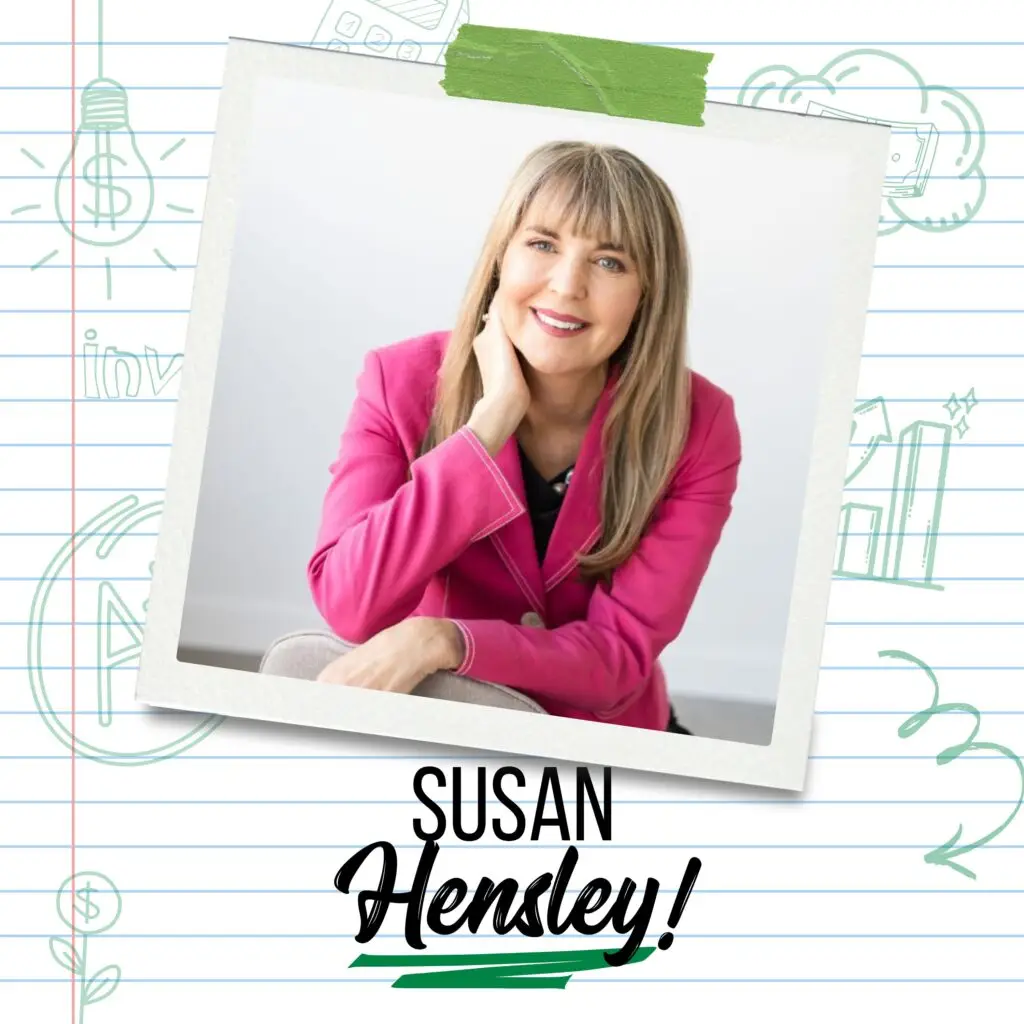
Welcome back to Don’t Retire… Graduate! In this episode, we’re diving deep into the emotional and creative side of life’s biggest transitions—especially retirement. My guest, Susan Hensley, is a transformational coach, speaker, and author whose mission is to help individuals navigate major life changes with joy, creativity, and resilience. With decades of experience as a corporate executive and leadership coach—and a background in HR and journalism—Susan brings a unique perspective on how we can move through uncertainty without losing ourselves, and, in fact, discover new meaning and color in our lives.
Susan and I explored not just the financial aspects of retirement, but the psychological transformation it brings. We talked about the loss of identity, the paradox of newfound time, and why many of us feel adrift or even terrified approaching this stage, despite years of planning. What sets Susan apart is her use of art journaling as a tool in her coaching practice—a process open to anyone, even self-professed non-artists like me! Susan described how creative expression helps process emotions, unlock inner wisdom, and rediscover the sense of play we all had as children. Together, we discussed letting go of the “big P” purpose that often defines our working years and embracing instead a series of “small p” purposes rooted in daily curiosity, microlearning, and the willingness to experiment and shed old identities.
The episode is both reassuring and invigorating, reminding us that the journey into retirement—or any major transition—isn’t a one-time molting, but an ongoing metamorphosis filled with opportunities to reinvent ourselves, explore new interests, and find joy, even in the messy middle. Susan shared practical advice for managing the daunting blank canvas of retirement, finding joy in both purpose and in play, and learning to balance optimism and fear as we take on the next chapter.
Key Takeaways:
- Art Journaling as Transformational Coaching: You don’t have to be an artist to benefit from art journaling—it’s a tool for self-expression and emotional processing during uncertain times, accessible to anyone who can doodle, collage, or simply make marks on a page.
- Reimagining Purpose in Retirement: Life after work isn’t about finding a new singular “big P” purpose, but rather about embracing a series of “small p” purposes that evolve, shift, and can be explored daily through curiosity and microlearning.
- Managing the Identity Shift: The transition into retirement brings grief, loss of status, and uncertainty about who we are, but it also opens opportunities for shedding old identities and trying on new ones without long-term commitment.
- Structuring the Blank Canvas: If you’re used to being busy, it helps to gently reintroduce structure post-retirement—but leave intentional space for creativity and exploration, embracing both boredom and talent for value creation in new forms.
- Joy as a Guiding Principle: Purpose and joy are not mutually exclusive; in fact, real fulfillment comes when we allow them to intersect—by finding glimmers of excitement and allowing ourselves to pursue whatever sparks curiosity, even if it ends up being a brief detour.
Join us as we challenge assumptions, confront fears, and celebrate the potential for play, curiosity, and new beginnings at any stage. Don’t forget to subscribe, rate, and share this episode with anyone ready to graduate into a more joyful, inventive future!
For more on Susan Hensley, including her book Art for Your Sanity and free downloadable resources for art journaling, visit susan-hensley.com. Let’s inspire each other to stay both terrified and optimistic—and above all, curious—about what comes next!
Transcript
Welcome to Don't Retire Graduate, the podcast that asks you what you want to be when you grow up so you can graduate into retirement with purpose and with passion. I'm your host and valedictorian, Eric Brotman and this is the sixth season of our show. Every other Thursday we'll be bringing you interviews with amazing guests and on alternating weeks we're hosting our Diary of a Financial Advisor segment where we interview financial advisors about their professional journeys and and their passion for helping others succeed. If you haven't already subscribed, please take a moment and do so so you never miss an episode. Today I'm pleased to be joined by Susan Hensley. Susan's a transformational coach, a speaker and an author. She's dedicated to helping people navigate life's transitions with joy, creativity and resilience. With decades of experience as a corporate executive and leadership coach, Susan has a deep understanding of the challenges and opportunities that come with major life changes.
Eric Brotman [:Drawing on her extensive background in HR coaching and journalism, Susan's mission is to empower people to unlock their inner wisdom, creativity and sense of play during times of uncertainty and change. Through workshops, speaking engagements, and one on one coaching, she guides clients to rediscover their authentic selves and infuse their lives with more color, meaning and joy. Susan, welcome to Don't Retire Graduate.
Susan Hensley [:Oh, thank you Eric. It's a pleasure to be here.
Eric Brotman [:I'm very excited for this conversation for lots of reasons, one of which that you don't know is that I'm going through a fairly major professional transformation now and am a huge fan of Joy. So I might get some free coaching today for our audience to enjoy, which I would be delighted to receive. Your book is interesting and I want to talk about it. But first can you share a little bit about how you decided to do coaching and how you decided to help with transformational leadership?
Susan Hensley [:Sure. And in many cases what we experience in our lives and the lessons we learn, hard lessons born through experience and trial and error, we then want to share to help other other people. I have gone through some very significant life transitions. We all have it at a certain life stage between no career shifts, moving globally, caretaking, and when I was an HR executive, I had the ability to do a lot of certifications that really helped develop my coaching skills. Then with the art journaling, I was learning how we inside ourselves know how to unlock our best way through transitions. We just need a little bit of help and guidance so that we don't get some stuck in those negative, negative thought loops because it's very scary when you're going through a transition and if you can move to joy. And Eric, I love the fact that you said joy is sort of a beacon for you and something you're seeking because when we have joy versus fear or chaos or anxiety, it really opens up the world of possibilities and allows us to enjoy the process. It's really not.
Susan Hensley [:Transitions really aren't about the thought final destination. Because some of them really big life ones can take. I hate to say this, but they can take years to really get to the new place and then, dang it, if there isn't another transition coming right after that. Because that's just the nature of things.
Eric Brotman [:Well, I do want you to know that I find joy in chaos. So, you know, some of these things don't have to be mutually exclusive. I like a little bit of drama in my life, so maybe you can give me some of that too. You, you also, you also, you also use art, which I am dreadful at, but you use art. And I watched some of your videos and I saw that you said there is absolutely no requirement that you be talented in art to use some of these tools in your book. Tell us a little bit about the book and why it was so important for you to write it and share it with the world.
Susan Hensley [:Sure. So let's just start briefly with the title. So. So Art for your sanity. How art journaling can manage Chaos and unleash joy. So chaos is natural. And I appreciate you said that because it isn't necessarily an either or. It's how we feel during the time of change and where we keep our vision.
Susan Hensley [:And that's a joy. And I appreciate the way you said that. So the book is very much for people who would say they're dreadful at art. So I want to actually say you and people who say, say I can't even draw a stick figure because I'm one of you. Right. I. I am still in the four and five year old place. And that's actually where the people I work with, I want them to be.
Susan Hensley [:Because there's no part of this book or the coaching. The, the art is really just a tool in the transformational coaching. And when we don't have attachment, when we don't have a lot of ego tied up in producing art or making art, that's where that sense of play, of exploration, that's where you rediscover that 4, 5, 6 year old artist that was just having a great time with whatever. Crayons, finger painting, play. D'oh. Right. It all Sort of depends when you grew up. That's actually what you're tapping into as you play with art.
Susan Hensley [:It is not about making something to hang in a wall, and it's never about showing another person. It's about expression and processing emotions during times of uncertainty.
Eric Brotman [:So I've heard dozens, if not hundreds, if not thousands of people espouse the benefits of journaling. I have seldom heard people espouse the. The benefits of doodling, which is what I'm now perceiving this to be is sort of a. More of a visual and less of a. An articulation necessarily of feelings. Maybe it's designed to be both. This is different. I mean, you know, I've heard, oh, you must journal.
Eric Brotman [:You write these things down. It's therapeutic. It's. It's cathartic. It's lots of things. And. And then you can look back on it, which some people do, and other people say, no, absolutely, don't even keep it. It's like typing that email that's emotional and then not sending it to anyone.
Eric Brotman [:Just sort of getting that out and then making it stop. Where are you on sort of that spectrum of. Is this something to embrace and revisit? Is this something to sort of spew on paper and then. And then catalog and forget? What is the. What is or is it different per person?
Susan Hensley [:Yeah. So I, I really appreciate the way you. You frame that, Eric, because there's a. There's a lot of things there. So I want to start with, yes, it's all of those. And let me explain a little bit more. I had been a lifelong journaler. In the intro, you wrote that I had a first career as a journalist.
Susan Hensley [:I spent 12 years in television journalism. I'm very comfortable keeping a journal. I've probably kept a journal since. Since college. I only in the last eight to ten years now started playing with art in that way. And I have found two things. I still do some written journal, but many times I. When we are writing things down, we will go in a loop and we have a little bit of judgment and we're still in, if you will, the left side of your brain, the analytical, judgmental side, that although it feels good to.
Susan Hensley [:To vent, you're almost editing is your writing. What I love about art journaling, and I treat it exactly like I treat my journal. I don't run around showing my written journal anyone. I can't even read my handwriting. So I'm one of the people who really doesn't go back. I want to admit that I couldn't read it, it's much more fun for me to and look at my art journal entries because although they're collage and stick figure and messy, and some days there's just little screaming faces or hearts. I mean, I'm talking four and five year old release stuff. The images and symbols.
Susan Hensley [:As humans, we are meaning making machines. We're always looking for meaning to help us understand our lives. Right. Because it helps to. To ground us and give us direction. I've actually found looking back at the art journal entries to be really helpful, instructive. You don't have to. Some people need to burn it if they're processing really difficult emotions, throw it away.
Susan Hensley [:There's some real, if you will, symbolism in processing a difficult emotion. You come to the page in a rage or disappointment or sadness, and it can feel really good to burn a page over a, a sink or something or wad it up and throw it away. So there's real benefit as a coach in using physical expression, if you will, to process a difficult emotion. There's also value in being able to reflect. So I actually love the way you asked the question because depending on you, your circumstance, if you are working with a coach or someone, you may do everything you described.
Eric Brotman [:Okay. I think one of the biggest transformations that we all go through, hopefully if we live long enough and we're able to do it, is this concept of retiring. I mean, certainly there's marriages and divorces and scholastic achievements and work achievements and new jobs and new moves. And there's lots of transitions in our lives, but one of the very, very biggest is this heavy lift that is called retirement. Like we're suddenly going to go from working 50 and 60 hours a week and being productive to, to Oprah and shuffleboard. And it's, it's, I think, terrifying to a lot of people. Partly financially, it's a little terrifying to say, well, if my paycheck stops, am I going to be okay? And that's the financial side, that's your left brain side. But then there's also the piece that says, what am I going to do? I'm going to suddenly have a different, a different set of, of issues and time and schedule and things.
Eric Brotman [:What am I going to do so that I'm not sitting around waiting to die? Which candidly, I don't say that flippantly. I say that because that's what some people do. Retirement's a scary thing. You plan for it ideally since your first paycheck. And then as it gets closer and I'm leaning towards my own transition here. And I'm going to come back to it because I'm not letting you get off this, this episode without, without providing me with some, some joy and some wisdom. Hopefully both. But nonetheless, this is a really scary time for people.
Eric Brotman [:And so can you talk about the coaching that you've done with folks in that stage of life and how you've helped them navigate something that feels so much like an end, but can also be a beautiful beginning?
Susan Hensley [:You are absolutely right. So terrifying. Adrift. Purposelessness. I'm afraid I'm going to lay on the couch and watch Netflix all day. I don't want to die. There's a lot of really deep fears because there's stories in our culture about the person who worked their whole life retires and, you know, drops dead. So you could not have hit the nail more on the head.
Susan Hensley [:And yes, I've worked with so many people. And what I love about your the title of your podcast. Right. Rather you're meaning, you know, don't retire, graduate, if you will. The implication is all about continued growth. And that's where I come at it from. Now, I will say I completely agree with you that in all of the various life transitions that can be out there, except for probably a catastrophic health illness, this, the retirement in our culture is one of the biggest. There's a loss of status, of perceived power.
Susan Hensley [:It is wonderful to have control of your day and your time, and it is terrifying to have control of your day in your time. And that's the paradox, I believe, of retirement. There are some people who retirement comes more abruptly than others. It may not have been their choice and they find themselves in that. And that's what we talk a lot about in transitions. Transitions can be something we choose or something done to us. And they're about 50, 50. But no matter how you enter retirement, and this is what throws people off who've planned for retirement and it's their choice, there is a real grieving still.
Susan Hensley [:There's a deep, deep loss of identity. There is a whole sense of who am I now? And people would like to get that answer very, very quickly. And the hardest thing to accept is that when you are working 50 to 60 hours a week, you may think you know who you want to be in the next stage, but it's actually very hard to know because you, you haven't felt yourself with a wide open calendar. So the what? Let's just pretend finances are not a constraint here. The unlimited travel or fishing, golfing time with grandkids, whatever it is that unlimited thing sounds so appealing because you are so time constrained. And if you've worked your entire life like I did, you really can't picture having open time. You haven't had open time since you were a small child before school. So you're in a whole new view of yourself.
Susan Hensley [:And that's where I think coaching, art journaling, many things. Just like so many people have a financial advisor, having a person to help you through the stage because there's an ending that needs to really be processed. And it's not about a retirement party per se, that's just the, that the start of it is what does it feel like depending on your position, to not be able to pick up the phone? And if people do things, even your former employer, if you're from a fairly large company, to call and be able to get benefits or questions answered, it's a little different. You fall much lower on the, the list of everyone's priorities. And there's a lot of what I would call you. You don't think you've got these, these egos that are attached to it, but we all do. And it's normal and natural. So there's this massive shedding of skin, just like a snake.
Susan Hensley [:And it's layers after layers. It doesn't happen all at one time. Very messy middle about who am I? And I thought I was going to love this, but after six months of whatever, I stopped loving it. And if, if you're a person who worked in the same profession, you didn't have to work for the same employer, but if you worked in the same profession for a number of years. One thing that I see surprise a lot of my clients is that after six, 18 months, even two years, they may not want to keep up with the same hobbies, the same maybe consulting the same side interests. And that that's actually okay. You don't need, need to do something when you retire for years and years again, it's understanding that you may cycle through interests, maybe small businesses, some part time exploration every six months, every 18 months. And that it's okay to try something on and play and be curious and then say, you know what, that's not me.
Susan Hensley [:But having always been a worker, that's really hard for people. They feel that they have to find this next act, whatever it may be, and then commit to it for years and years. And I do a lot of work with clients that this is a time of, of play, of exploration. We've used joy. You started with that. Joy is such a life giving emotion. But if you do the same thing every day, it can become routine. It doesn't mean it stops giving you joy.
Susan Hensley [:But a lot of what's embedded in joy is an exploration. It's finding, like, little glimmers of things that excite you. And I think that's one of the biggest misperceptions my clients have when they retire, is, okay, I'm gonna do this, and this is the new me. And then all of a sudden, it's not, or it stops fitting. And how okay that is, because money, financially, hopefully, you are on a glide path that is steady and is predictable. But in the rest of your life, it's actually really fun to be an explorer. And so there are two sides of the coin, but you approach them really differently.
Eric Brotman [:Well, first of all, I have an image of myself molting now, so thank you for that. That was not my. That was not what I expected would happen this morning when I woke up. Secondly, you talk about joy sort of. I think what you're describing is. Is referred to as the law of diminishing utility. This idea that something that brings you an enormous amount of joy, if you do it every single day or all the time, that dopamine hit, that joy hit can actually get smaller. And I'm sure there's examples where that's true and examples where it's not.
Eric Brotman [:So I don't mean to paint it with too broad a brush. So let me share with you. I've been sharing this message with people for 30 years, which is that you want to reinvent yourself. You want to create new pathways and new exciting things, and that you want to live with purpose and passion. You know, I think a life with purpose is really important, and a life without purpose is almost not worth living at a given point. But I never incorporated joy into that until it was my turn. And I know that's an interesting thing, and I'm discovering this about myself, that it was about purpose when it was professional, almost like it was a clinical discussion. But once I put my own hat on and said, you know, I'm getting ready to.
Eric Brotman [:st of:Susan Hensley [:Well, I believe they absolutely come together. And should I want to, because this was really interesting and this is not original to me. So I want to give full credit to like modern Elder Academy. I think in the working years purpose has a big P, a capital P. And it can feel very singular, like why am I doing what I'm doing? I think what happens in retirement is we can look at purpose almost daily, if you will, with a small P. It doesn't have to be a singular thing. So the work we do on understanding our values, our deep intrinsic values, which always tie to purpose, but recognizing there can be in a day a different. And it's not an intention, but a different purpose in a season.
Susan Hensley [:You talked about molting another, you know, I used the snake shedding its skin. And other really popular metaphor for this stage of life we're talking about is the caterpillar, the chrysalis, where you go to goo and emerge as a butterfly, right? Where you are literally not the same. And that's how big I think the retirement or next phase really is for people. And part of that is redefining purpose and that there may be a series of, of small P purposes. And to start to view purpose because of the amount of time we may have left, health constrictions as less grand and all encompassing because that can really stymy people. And that's where you hear I feel purposeless, I feel adrift. And we will do some values work about, like what really are your, your core values and how could that show up on a day where you're not working 10, 12 hours where you have a wide open day? Is there a way for it to show up in the small interactions as you go about their day? Is there something to I call microlearn? Spending 30 minutes exploring a topic that you sort of intrigues you, but you've never gone any deeper. It doesn't mean you're going to go take an entire course in it.
Susan Hensley [:It doesn't mean you're going to become an expert in it. But what are these little micro explorations, micro curiosities you can build into your day that are small P Purpose. Right? You may say, I'm going to take the next couple months and my purpose is to be an explorer. And that may not mean leaving your house. It's not about a great trek halfway around the world. It can be, it could just Be learning something, talking to a person you've. You've never talked to as you go about your way. Because before you were so busy.
Susan Hensley [:We all know what it feels like to be, like, so busy. And when someone says to you, how are you say crazy busy. So I really like to work with clients on demystifying what I call that big capital P purpose, and bringing it into something smaller about exploring and curiosity. And that's what's bringing us back to joy. Because when we are curious, when we're wondering, huh, what about this? I'd like to know more about this. That's what sparks joy. That's what can spark a glimmer. And that's also what can tell us.
Susan Hensley [:You know, I always thought I wanted to learn another language or I wanted to learn drums. And, you know, I. I took a lesson or I took two, and that's great, but that's not for me. It's also getting really comfortable saying what's not for you.
Eric Brotman [:So, you know, you talked about busy. And Bill Gates, I think, was the one who said, busy is the new stupid. And, you know, and truly, because filling our calendars with things that. That can be just as vacuous as anything else makes no sense. And there's a certain amount of pride and even bravado about saying, I'm super busy. My time here, my calendar is constricted, and everybody wants some time with me. And there is ego around that. I don't know if that's a male thing or if it's a human thing.
Eric Brotman [:I'd be curious your opinion on that. But in terms of this being more of a. You talked about the chrysalis. This is now a metamorphosis rather than a transition. It really is a reinvention, and I don't know that it can be done in one step. And so I love this idea of maintaining curiosity. I love this idea of learning some new things. I can't not have something to do.
Eric Brotman [:I mean, first of all, if I putter around the house, forget it. I'm bored in three days. Even on vacation, if I don't have some kind of exercise to do or some kind of place to go or some kind of. Some kind of destination for the day, even I get bored out of my mind. And so I'm terrified, actually, of having nothing to do. By the same token, I don't want to just fill my day with stuff. I mean, that. That's not living either.
Eric Brotman [:That's like whack a mole. So, you know, you get to advise me now coach me. What in the world do I do? From going from feeling really proud about boy, I'm busy and I'm in this town and that town and I'm traveling a lot and I'm, I'm working with people all day every day and to suddenly saying, wow, I've got this, this awesome blank canvas to recreate. What am I going to do with it? Yeah.
Susan Hensley [:So I resemble you or I did that. I had people as I was getting ready to, to leave my executive job, say what are you gonna do? You're gonna go crazy. Very unhelpful. Well meaning but unhelpful. You know, you have so much energy, you're so busy and I got more and more scared. Right. Even though I work.
Eric Brotman [:Yeah.
Susan Hensley [:Because it's, it's scary. So I, I see you and here's, here's what I'd like to, to share because a couple things are true and they can compete. You use the word metamorphosis. I think accepting that in the first years post being the CEO and say let's look out five years, you may go through two or three metamorphosis. It's not just, I think that's, that's the tricky thing about the, the chrysalis, the caterpillar to chrysalis to butterfly is it acts like the butterfly is the very, the end. And I think what we need to realize is in our human lives we may do that in certain periods several times. So getting very comfortable to. Another thing I like is like trees.
Susan Hensley [:If you, you live in an area where trees lose leaves every fall, like almost thinking of the, the post retirement years is being willing to grow and shed leaves. So for people who say they go crazy if they don't have structure and that's me, what I realized is I'm going to create structure that adds value, but I'm going to really extend end. And just because I was used to say getting up at five, working out, breakfast, meetings, big work, you know, lunch, dinner, work at night, work on weekends, family time with everything scheduled. You allow some periods of open space so you still create some schedule. You don't go from say 50 to 60 hours to zero. That's very, very jarring. But you start to pull it back in increments and, and you start to feel through exercises and observation what having space feels like. And I will tell you, there are days it's very scary.
Susan Hensley [:And if you're a person who's always identified as busy, that boredom is much scarier than anything else. And because it's an unfamiliar feeling. And so there's some tools and exercises you can do to. Can I sit with this for an hour? Do I have to have my mind completely going? Because what I have found is as you like toe step into being less busy and having free time. That's where with a few just exercises and questions, that's where you end up doing things you never thought you would do. When I retired, I never thought I would write a book. I never thought I would do a TED talk. I never thought I may go back to school.
Susan Hensley [:Right. There were things I planned that I announced I'm going to travel these places, I'm going to walk this. And like I. Because I felt like I had to tell people something, there was tremendous pressure on and I find this with so many of my clients like what are you going to do? You're going to go crazy and you have to come up with a story and you want a story, but being able to shed that. And in what I call the moments of boredom where the day is long. I don't know if you. You've heard this. It's a often used quote when it comes to raising a family.
Susan Hensley [:Days are long, but years are short. Getting comfortable, okay, because it becomes even more true. Very true. Raising kids more true. In the post full time work world of that reinvention any given day and it's getting comfortable. You might feel bored and then cranky and how do you process what that's like even for an hour but all of a sudden you turn around and you say oh my gosh, I left that job a year ago. And that's. It's getting comfortable in that space and finding these small P purposes that I have seen fuel clients to do all sorts of things they never imagine they would do.
Susan Hensley [:Because we are creative individuals, our impulse is to create, to add value, whatever that may look like. Maybe you just become a great, you know, fisher or golfer. Right. And that's. That's terrific. Maybe you make a whole new set of friends, maybe you take up a new hobby, start a new business. But if you allow yourself that little bit of space and you allow yourself the freedom to try things and discard them, it's amazing when you look back, even at three months, I like my clients to do a week in review, a month in review, a quarter in review. Because when you then go back because they'll say I'm not doing anything or I'm bored and you start to see the things you've actually done and we spend time saying what sparked joy what felt meaningful, that helps build a roadmap to additional meaning.
Susan Hensley [:But I think there's a little something in getting comfortable with some boredom because that's where the creativity is going to come into place. Very hard to be creative. The Bill Gates code, because it's stupid. Your mind's just. You're numbing yourself out with busyness and not creating value for your. Your heart, if you will, and for your soul. I don't mean creating value for, say, another.
Eric Brotman [:Right. Well, I can tell you this. I am now squarely straddling the line. Having spent a half an hour with you, I'm squarely straddling the line between terrified and optimistic. Only because you forced me to think of some things. My palms are sweating. I'm excited, I'm eager, I'm terrified. I really am.
Eric Brotman [:And I'm gonna want that 13 and quarterly check in and all those things. I know people watching this and listening to this want to hear more from you. How can they. How can they get a lot more Susan in their lives?
Susan Hensley [:It's very simple. My website and the contact me and the books there and. And there's free, downloadable. If you're at all interested in art journaling, you can Download a free PDF. So it's just susan-hensley.com. i seem to pop up all over the place there. And I want to say it's great and exhilarating to be excited and terrified. That means you're ready and to get comfortable with holding both of those things together.
Susan Hensley [:Because I think it's when we say, I shouldn't be scared. I'm an adult. I shouldn't have these feelings that we limit ourselves, that we keep ourselves small. I mean, think of when you started working, when you went off to school, when you went off to college, when you started a new relationship. It is good to have that full mixture of feelings. That's that creative impulse that's really going to open you up to a terrific next chapter.
Eric Brotman [:Well, we will put all of your contact info in the show notes so folks can check you out. I strongly encourage everyone to, because this has been spectacular. I can't let you get off the show without answering one last question. And I. I can't wait for this answer now. There's enormous pressure on you, just so you know. I want you to be terrified and optimistic. It's my turn, and you should be.
Eric Brotman [:Susan, what do you want to be when you grow up?
Susan Hensley [:You know, I want to be curious. I do. I think that if I can stay curious, it's served me really well these last few years. You know, I could say, you know, all the things I'm working on, but at each stage, to just stay, that feels interesting to me. That feels exciting. So I. I want curious.
Eric Brotman [:I love that. Thank you. I can't thank you enough for spending some time with us. I know everybody got a lot out of this. I know I did. Susan Hensley, you're amazing and I appreciate your time this morning.
Susan Hensley [:Oh, thank you. It was terrific.
Eric Brotman [:I'd like to thank everyone for watching and listening today. If you enjoy our show, please share it with friends and family so they can join you on your journey to financial freedom. And please take a moment to leave a rating or review on your favorite podcast platform. Those are priceless to us. We'll be back next week with another diary of a financial advisor and in two weeks with another engaging guest. For now, this is your terrified and optimistic host and valedictorian Eric Brotman, saying don't retire. Graduate.
Unnamed Voiceover [:Securities offered through Kestra Investment Services, llc. Kestra is member finra, SIPC Investment advisory services offered through Kestra Advisory Services llc. Kestra as an affiliate of Kestra is Kestra is or Kestra as are not affiliated with Brotman Financial or any other entity discussed.