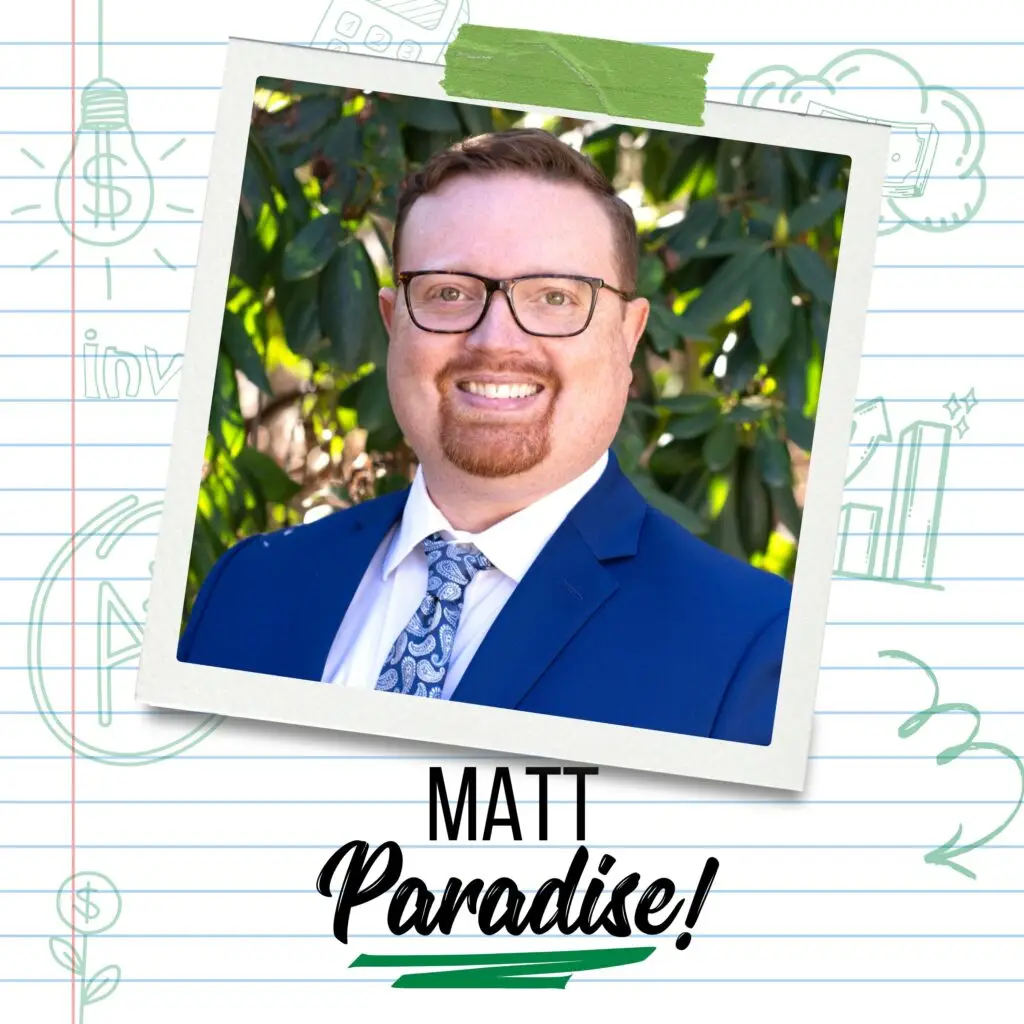
Welcome back to Don’t Retire… Graduate! On today’s episode, I’m joined by a truly inspiring guest whose personal journey offers hope, resilience, and valuable lessons about financial wellness: Matt Paradise. Matt is a financial wellness speaker for young professionals, an award-winning author, and a living example of perseverance—having gone from being a homeless teen to achieving financial independence and now dedicating himself to helping others beat financial stress and unlock their full potential.
In our conversation, Matt and I dive deep into his incredible story of transformation, moving from addiction and hopelessness to sobriety, stability, and success. He shares candid reflections on the intersection of addiction, mental health, and financial habits, reminding us that these struggles can affect anyone, and that there’s always hope—even in the darkest times. We talk about the ongoing commitment involved in both addiction recovery and financial wellness, as well as the pivotal role that mindset, mentors, and community play in helping us overcome adversity.
Matt draws on his decades of experience in credit counseling and financial coaching, sharing powerful insights into behavioral addictions like overspending and debt accumulation—and how these patterns often stem from deeper emotional or psychological challenges. He recounts his own family’s story of long-term financial planning, caring for aging parents, and the anxieties and transitions that come with giving up independence later in life. Together, we explore the importance of vision, purpose, and building support systems—whether for our children, our elders, or ourselves as we pursue wellness and growth at every stage.
5 Key Takeaways:
- Pain to Purpose: Matt’s journey shows that personal pain can be transformed into service and purpose—helping others find hope and resilience amid their own struggles.
- Recovery Is Lifelong: Addiction recovery, whether chemical or behavioral (like debt or spending), is a lifelong process. Accountability, support, and “speaking the truth in love” are critical for lasting change.
- Financial Wellness Is Holistic: True financial wellness goes beyond dollars and cents—it’s deeply linked to mindset, emotional health, and the support systems we build. Financial anxiety can persist even after basic needs are met, especially when rooted in past trauma or scarcity.
- Generational and Individual Challenges: Our experiences around money, independence, and mental health are shaped by generational patterns, cultural backgrounds, and personal histories. There’s no “one-size-fits-all”—every journey is unique.
- The Importance of Vision and Purpose: Building a vision for our future—even if it feels difficult or intimidating—is essential. Whether planning for retirement, caregiving, or breaking out of survival mode, a clear purpose helps us create better present and future outcomes.
Join us for this powerful and motivating episode as we shine a light on overcoming adversity and creating financial and personal well-being through mindset, action, and community. Don’t forget to subscribe, rate, and share this episode with anyone who might benefit from a message of hope and practical wisdom—on their journey to financial freedom and purpose-filled living!
Access special book bonuses from Matt’s award-winning and best-selling book, Financially Capable: A Friendly Guide to Building Whole-Health Wealth, here: https://www.mattparadise.com/capablebonus
Transcript
Welcome to Don't Retire Graduate, the podcast that asks you what you want to be when you grow up so you can graduate into retirement with purpose and with passion. I'm your host and valedictorian, Eric Brotman and this is the sixth season of our show. Every other Thursday we'll be bringing you interviews with amazing guests and on alternating weeks we're hosting our Diary of a Financial Advisor segment where we interview financial advisors about their professional journeys and and their passion for helping others to succeed. Please take a moment, if you haven't already, to subscribe so you never miss an episode of the show. Today I'm pleased to be joined by Matt Paradise. I think you're going to love Matt's story. Matt's a financial wellness speaker for young professionals, an award winning author and a living example of resilience. Once a homeless teen, Matt became a self made millionaire and now helps organizations reduce employee money stress to unlock greater focus, productivity and performance.
Eric Brotman [:His inspiring journey from survival to success, including overcoming bile duct cancer and a life saving liver transplant, makes him not only relatable, but unforgettable. Today, Matt equips leaders and teams with practical tools to turn financial stress into strength, fueling individual well being and better business outcomes. Matt, welcome to Don't Retire Graduate.
Matt Paradise [:Thanks so much Eric. I'm grateful to be here.
Eric Brotman [:Your story is so compelling that I don't want to waste any time in getting to it. So if you can share a little bit about some of your history. Some of the. I mean, homeless to Self Made Millionaire is not something we hear every day and the fact that you're bringing wellness to other families and other people is totally inspiring. We'll get to some of the professional work toward the end of the show, but why don't you share that experience with us? We'll try and put ourselves in your shoes to the extent we can for a moment or two.
Matt Paradise [:I'd love to. I think one area that I'd like just to tweak a little bit is the idea of Self Made Millionaire. There are so many mentors, so many teachers, so many advisors throughout my journey that helped me to become who I am today. And I'd be remiss without saying that, so self made I'm not. There've been many along the journey and for that I'm grateful. So as you mentioned in the intro, Eric, there's so much in my history of overcoming and I like to think of it as pain to purpose and the pain was significant, much of itself inflicted. So without too many details and going into all of that as a teenager I got heavy into drugs and alcohol. As a sophomore in high school I ended up moving out of my family's house, sold drugs for a living, overdosed while still in high school.
Matt Paradise [:Was actually at the school the school nurse called 91 1. Through all of that there's so many stories, so much challenge and ultimately was. Was something that really forged who I am in a lot of ways. I pause and even just to find the words because there's so much in there, there's so much pain, there's so much challenge and as a result also so much gratitude because I've survived. So I knew that I needed to change. I grew up in Connecticut through all of those challenges, moved to Massachusetts looking for change because the house where I was living was raided by the police frequently and our teenage friends were stopped after trying to attend parties or just visit after school and for anyone. Maybe, maybe you can't necessarily relate to the extreme nature that I took drugs and alcohol. Maybe you've never even tried drugs and alcohol or had a problem with them.
Matt Paradise [:But maybe you've had a challenge that you've wanted to completely change your life. To find some sort of new beginning. For myself when I moved to Massachusetts I found that when I moved I took all my baggage with me. I was still me. I couldn't leave that behind. And maybe you've tried to change location, maybe you've tried to change some significant things, get some significant help. My message today is one of hope. There is always hope and never give up.
Matt Paradise [:If you feel as a listener now that you're overwhelmed by life, regardless of your stage, maybe it's kids that you have that now are getting into their own troubles and bringing up memories for you when whether of your past or new experiences altogether and new challenges, there's always hope. I have a 15 year old now and we're working through some significant challenges as well. So I know what it's like to work through challenges at different ages and stages. There's always hope. So I moved to Massachusetts to get away from that and by grace, a friend reached out, invited me to play. In my past I was a professional musician. Congas, bongas, Jimbe, all the percussive fun stuff and played with amazing band, Best of Boston Band. And he invited me out to this bible based drug recovery program and I was like thanks, I'm good, that's not for me.
Matt Paradise [:program. And By Grace, since:Eric Brotman [:That is. That's a lot. That's intense. And, you know, I have a teenager also and am, you know, both proud of her for making good decisions and terrified of some of the ones that are out there to be made, some of which are life changing in an instant. And it sounds like you went through. It sounds like you went through a really incredibly dark period. I assume that it was a lonely period. And maybe you can talk a little bit about the intersection of addiction and hopelessness and maybe mental illness, which I think come.
Eric Brotman [:Come together a little bit. And that's defined so many different ways. I don't mean it to be derogatory in any way. I just think there's things that drugs and alcohol can affect our brains and so can helplessness and the lack of hope. So the fact that you discovered that was incredibly important. And this is a message a lot of people, whether they're teenagers today, who, most of our listeners are not teenagers, most of them are parents and grandparents of teenagers. And therefore, I think this is a message of. Definitely a message of hope.
Eric Brotman [:So addiction is something you battle with your whole life. I mean, you're 26 plus years sober, which is amazing. Congratulations. That is a hard thing to do. How involved are you now with any type of recovery programs for others? Or are you still involved in some of the Bible programs and the recovery programs today? Or. Or have you almost entirely moved on from that is. I understand it can be a real lifetime, real lifetime commitment.
Matt Paradise [:It is a lifetime commitment. And people in my life are ones who I'm eternally grateful for because they continue to help me even when I might necessarily make the best choices. They're there to remind me, dude, what are you doing? Sometimes I need some quote unquote, tough love. And the importance of speaking the truth in love is critical. Sometimes as a dad, I want to give my son a quick, swift kick in the pants. And sometimes we need that extrinsic motivation, not the kick in the pants. But the love that's spoken in truth too often I want to, as a people pleaser, sugarcoat the truth, be able to just continue to say everything will be okay, everything will turn out right, regardless of consequences for particular actions. And we can't say that with certainty there are consequences to our actions.
Matt Paradise [:So when you mention the importance of mental health, we see it dominating headlines today as we record last year before our recording and I'm quite certain, unfortunately next year as well, there will be headlines about the challenges of mental well being. Part of that is challenges to access competent care at all different ages. I mean, as we think about not retiring, but graduating, graduating to what is the question that you continue to speak about, to answer for so many and mental health in later years is significant. My wife and I are caregivers. Her dad unfortunately passed away a couple years ago, but our plan came to fruition because he was able to do so in the addition that we built for him. Her mom, we continue to work through mental health challenges. She's otherwise physically healthy, she's 80 years old. But her mind is not just her mind, but everybody's mind is incredibly powerful.
Matt Paradise [:The importance of a positive mindset through all life ages and stages, whether as a team for our kids and grandkids, as you mentioned, for listeners, Eric, for ourselves and maybe even for others who are in our care, is critical. So mental health is a huge topic, certainly more than we have to cover it in this time. But you asked the question specifically about addiction. For me, it is a lifelong pursuit of working towards sobriety because it's not just chemical recovery, it's character recovery. It's recovering parts of my childhood that I tossed away some by decision. Mental health, deep depression, suicidal ideation and attempts. There's a lot in those years. But when we talk about addiction again, maybe listeners can't necessarily relate to deep clinical depression or alcoholism or drug addiction.
Matt Paradise [:But some psychologists estimate that 100% of the population at one time or another are encumbered by some particular type of addiction. And there's process addictions. For my 25 years in credit counseling and now I serve on a board of one of the Forbes or Forbes number one credit counseling agency in the country. We see every day addiction to debt, addiction to spending, addiction to gambling. And there's debtors anonymous, spenders anonymous. They're vitally important because it's not just about the dollars and cents, it's not just about the money. It really is about the character, about the mental well being, about building whole health wealth, thinking about all the different domains of well being in our lives so that an area isn't left behind. And when we talk about mental well being and health, it certainly is tied to financial wellbeing because it takes a lot of resources, it takes a lot of time.
Matt Paradise [:Sometimes it leads to loss of employment or loss of jobs, or you can fill in the blank. Maybe as a listener you've felt or experienced some of those challenges and I'm with you and it's hard, but again, there's always hope.
Eric Brotman [:So first of all, strong, incredible message and you're 100% right. Whether whether you've dealt with the chemical addiction or not, there's lots of addictive personalities and people have issues with food, they have issues with substances, they have issues with spending. You're absolutely right that credit is, you know, bad credit is a noose around your neck that people just keep tightening and tightening and it's, it's very scary. So I'm glad to hear you're involved with that. I want to shift a little bit to talk about, to talk about some of the work you're doing in financial wellness. You know, we've, we've made financial wellness a priority at BFG and within our, within our organization because we realize that any form of wellness is a step in the right direction. You talk about it being a journey. There's lots of kinds of wellness.
Eric Brotman [:And for us as professionals, whether it's from a consulting standpoint, an advising standpoint, or just a volunteering and human standpoint, helping other people find wellness in your lane, where you're, where you excel. I can't help somebody with cardiac wellness, but I can help them with financial wellness. We all have our own strength. So talk a little bit about that work and how the impact of financial wellness, financial literacy and education that hopefully lead to financial wellness, how that's transforming lives. Because I imagine you're seeing some incredible success stories as well as maybe some real challenges along the way.
Matt Paradise [:It's so true. And there are many, I've estimated somewhere north of a hundred thousand different people that I've worked with. And each specific example is significantly different. The story that I'll share is one closest to my heart. And I shared this story of caregiving with my mother and father in law. My wife and I made the decision 20. It was about 20 years ago, 21 years ago, as they were getting to an age that were still fully self sufficient, independent living on their own. But the maintenance, the upkeep of their home was getting to be too much.
Matt Paradise [:Their daughters had Grown started their own families and I was the emergency plumber and the emergency electrician and the person who they called for everything in working a busy career and building, building a life with their daughter, my wife, who is amazing, incredible. Shout out Elsa. It, it was challenging to move back and forth. They started to think about downsizing, getting a condo, moving into senior living, senior housing. And we made the decision to move them into our home and we built an addition so that they'd still maintain independence but we could be close nearby. And it was a long term plan. I think what I've seen too often in many different arenas is the drive for instant gratification. I see that in my 15 year old son to the extreme because it's always living for the moment.
Matt Paradise [:Nolo, yolo. You only live once. You can show I'm showing a little bit of my age by saying nolo instead of yolo. Then he doesn't even say yolo because that's probably several years behind us now. Yeah, but thinking beyond the quarter, the term, the day, the week, the month, the year, five years, even a decade is really important when we think about well being. So there's the drawing near and drawing far. So the drawing near, we need to be well today, we need to do the things that build wellness for our future and we need to be of stable, sound, clear minds today. And that's a balance because our present self, our future selves are constantly battling for what's most beneficial.
Matt Paradise [:For my wife and I, we thought in terms of decades. And even though as I mentioned, my wife, her mom is incredibly healthy, my wife's grandmother is 100 years old. So to think that my mother in law could live for many more years is reasonable. That's still two more decades and that's two more decades of encouraging her towards well being. It's not just financial. We have an irrevocable trust, we have financial pieces in order. What she has struggled with is even finding that peace, wondering about all the what ifs, what if I have catastrophic illness. And we've seen it in our house.
Matt Paradise [:My father in law, who he cared for, had lung cancer, I had bile duct cancer, he succumbed. Being 80, I by literally the grace of God survived, had the liver transplant so that I could survive. But it's traumatic to the whole family when we think about cancers and when we think about falls. For as we age, they become greater and greater risks to significant changes of life and reduction of mobility. Thinking of those long term really is important because it's our homes in which we Live it's again, not just the money, but thinking about money in a way as we age so that we can be unencumbered and really have joy. It's not necessarily the biggest pile of cash. She's okay financially. My wife and I cover all of her bills.
Matt Paradise [:She doesn't have a worry about food or utilities or any of that. However, the worry, the stress, the fear, the anxiety is still there. And that's the conversation that we continue to have because it's not an instant turnaround, but it's ongoing work with the perspective of time, of decades. On the flip side, on the younger end of the spectrum, with our son, he's 15, we look back 10 years and we can see significant change. He's grown and matured in so many ways since he was five years old. There's research and data that shows we can look back in our own lives 10 years and see significant change and understand that that occurred. Assessing where are today however, the study showed that envisioning the growth over future forward 10 years is very, very difficult for the majority of the population, majority of people. But it's critically important to have that vision because where vision is lacking, even nations fail.
Matt Paradise [:We need vision for our own lives. We need the idea that we can build a life full of purpose, of hope, of resilience, regardless of the amount of money, but with the mindset that no matter what comes, we take it one day at a time and continue to build and grow and live each day with purpose. As I mentioned, for me and my story, it's a story of pain to purpose and purpose. Having the best of what I can give to others in service fulfills me in ways beyond imagination.
Eric Brotman [:The point of getting older, I mean obviously people say getting older is a privilege. It's also not for the meek, right? I mean it's a tough thing to do. And in your mother in law situation, I imagine when you talk about the fact that there's still some financial anxiety, even though she doesn't have to worry for anything specifically financially, how much of that do you think? And I don't necessarily mean just in her case, but in general, how much do you think is about relinquishing self reliance and self independence and control and the things that, you know, you're used to doing this. Nobody wants to have their keys taken away from them. That's their mobility, it's their and I mean literally or figuratively. So how do we balance that? My folks are both living in fact as we record this today is my mom's Birthday. Happy birthday. Shout out to my mom.
Eric Brotman [:Happy birthday. There you go. My, my dad's 86. My mom is 79 today. Don't tell anyone I told her. But, but nonetheless it's, there is some, some concern about what's coming. I, I can't see what's in their next five, 10 years. And they can't to your point.
Eric Brotman [:But there, there's a point where you have to, I think in most cases relinquish some level of independence or control and, and clinging to as much of it as possible that stays reasonable, healthy, responsible and all of that. That's a hard line to walk. And as, as the son or son in law that you and I both are in these various conversations in, in our lives, that is a hard line to walk. People are naturally really afraid to give up or lose independence. No one wants to feel that way.
Matt Paradise [:It's so true. Eric, I agree with you 100%. Fear is a huge motivator and often it's rooted deeply in our past. So as far as even that question in psychology, there's the idea if you think about the big red barn, that's all that you can think of. Right. As soon as I said that to audiences, don't think of the big red barn. Don't even picture a big red barn. To any listener right now, there's a good chance you're picturing a big red barn.
Eric Brotman [:I know I did. Thanks for that. Yeah, instantly. No, it's fine. I did though.
Matt Paradise [:Instantly.
Eric Brotman [:Yes.
Matt Paradise [:Fall is coming. I'm in New England. Big red barns are beautiful, especially with changing color of leaves. However, if all that we do is try not to worry, not to stress, not to have fear. And if all my mother in law here is don't be afraid, don't be scared, don't be anxious, all that she's going to do is have an increased level of anxiety, fear, worry. Some of. For we'll speak in specifics with. My mother in law is deeply rooted in her past and her development.
Matt Paradise [:Even as a kid, she grew up in China. Her mom escaped mainland China with the world war invasion of Japan, literally with a child on her back and went to Hong Kong. And from Hong Kong, eventually their family was able to get to the United States. And for my mother in law, she grew up going down to the stream to get water and wash clothes and had to haul that on our shoulders to have water for cooking and et cetera, et cetera. Scarcity was a way of their life. Survival mode is the mode that they lived in predominantly and when we live in survival mode, it's difficult to see the future, it's difficult to think about well being. We're so focused on just living another day. And that survival into ultimately abundance is a challenging journey and a different road for each person.
Matt Paradise [:For my mother in law there's deep work that I can't do for her because it's rooted in some of that trauma that she experienced as a kid and some of it's generational for her not even believing that working on trauma is a thing. And for me in my generation it's, we're sort of as a Gen Xer, we're on that cusp where it wasn't necessarily popular as a kid, there wasn't necessarily lots of help for my deep depression even in high school. Now certainly it's commonplace where there's performance psychologists and mental well being is pervasive throughout all areas of life. Whether it's school, whether it's work and career, whether it's retirement planning or otherwise. It's important to go through those steps, that healing journey because without it it's thinking of the big red barn.
Eric Brotman [:Is it possible the pendulum has swung too far? Because I agree with you, as a Gen Xer we were, we were latchkey. We let ourselves home, getting off the bus and all of the things and now we have a generation of kids who aren't. It's not even, you know, you've heard of Tiger mom, right? And then you've heard of the helicopter parent who's sort of always surveying. But I think we've gone to concierge parent which is a whole nother level. I think we have an entire generation of kids and this is unfair to say because every, every young person has their own personal story and not everyone's in a world of, of abundance. But for people where scarcity is not an issue, where survival is not an issue, it's called, and I use this tongue in cheek, it's called first world problems. But the fact of the matter is that I wonder if we've gone too far. If all of a sudden there is so much help, so much assistance, the safety net is so safe that risk becomes almost unacceptable.
Eric Brotman [:Any risk. You know, I'm not suggesting that we should put our kids on a high wire act or something with no net, but I wonder if we've gone too far. I wonder if there are too many types of those conversations. And I'm just curious because this is partly the world you and I are in, but is there some merit to that thought? Could I be onto something.
Matt Paradise [:I think as you said, the key is that it's an individual thing and for each person, maybe it is too much the tiger mom who's hovering over and super involved, or the concierge parent, as you say, who's super involved in a child who may not even need additional help. Is there an area that's too far that becomes limiting to that child's growth, development? I would say yes, most definitely for, for other kiddos. I mean, in the example of ours, there's a history of complex trauma through DCF involvement in adoption where there's additional help that's necessary to really provide the best possible future. So as I was talking about my mother in law and obviously she can't go back in time and she's not able to live as a kid in today's world. Her anxiety isn't rooted in lack. Her anxiety isn't rooted in inability to feed herself or the trauma of physically getting by. It's rooted some in the mindset that has been developed and curated throughout her entire life. And I think that as far as the pendulum swinging one way or the other, I think that it's much more of an individual than global, universal aspect to what's best for us as an individual.
Matt Paradise [:And for each listener, you're in a different place. Maybe you grew up with extreme poverty, maybe you grew up with childhood abuse. Those are heavy, serious things that if not dealt with, will pop up in many ways. I've worked with a lot of different clients with some challenges in their past with whether it's financial trauma, physical abuse or otherwise that affects them to this day. And oftentimes it leads to addictions. Whether it's spending, it doesn't have to be drugs and alcohol like we spoke about earlier, but I've seen credit card debt mount. The most credit card debt I've seen one person have was 500 grand that I helped a gentleman work through. And six figure credit card debt is commonplace.
Matt Paradise [:We have cumulatively in the country trillions of dollars of credit card debt. And as of this recording in this past quarter, the delinquencies are increasing. So certainly there's a problem. And it's not just unemployment, it's not just inflation, though those are significant and not to minimize those things as there are families struggling with food insecurity and struggling to put food on the table. And for listeners, maybe that's you reach out and there's help, maybe that's not you and you have more than enough, you have an abundance. Then the message is to Understand and realize that our neighbors, regardless of how affluent. I live in metro West Boston, one of the most affluent areas per se in the country, there are people who go to sleep at night without food, whether it's elderly and senior citizens, whether it's kids trying to get up and go to school. And there's some school programs and there's some things like Meals on Wheels and assistance that exists to provide food.
Matt Paradise [:But I mention that because each of us, our situation is different. And for some of us, for my wife and I, we are fortunate to have more than enough. And we found that it's incredibly fulfilling to get out and serve at a food pantry. We let a food pantry in the area for years, years. And be part of the problem per se, to grab a quote, to be the change that we want to see in the world. And as far as the balance, when we think about a pendulum swinging towards more, whether it's counseling, help, safety nets or less, and helping to promote risk in a healthy kind of way, it really is an individual situation because we are just so different in many ways as individuals. My wife and I are like polar opposites. I always joke.
Matt Paradise [:I obtained my ged, I was a high school dropout, even though I got my ged. Her opposite is she went to mit. She's brilliant in so many different ways that I'm not. The power of our differences is that when we come together to look at a challenge, our solution, when we work together is so much stronger, it's so much more complete and lasting than when we do it individually with our own strengths and weaknesses. So those individual strengths and weaknesses that we have, whether it's dealing with financial well being, whether it's dealing with financial planning and thinking about retirement or graduating to a different area of life beyond our careers, thinking about those strengths and weaknesses and the people within our circle is incredibly powerful. And whether that circle includes professionals like psychologists, psychiatrists, counselors or others, or friends that we can confide in and trusted consiglieres, the people who we know have our best interests in mind as we work and grow together. I need those people in my life. I need the people who I can walk side by side in life, live with, purpose and grow together.
Eric Brotman [:Man, I gotta tell you, we could do about six more shows with what we've talked about here today. I would love to do a show on scarcity, thought and sort of the impact that that has on people financially. I'd love to do one on some of the various insecurities. And I just, I feel like there's so much here and we are, we're running short on time. I'd like first to have you tell our listeners where they can get much more of you because they're going to want more of you after this, after this recording. How can folks get in touch with you whether they're interested in your content, your books, or to have a consult with you?
Matt Paradise [:My website, mattparadise.com is the one simple place to go. You can find, whether it's LinkedIn, my book, other ways to reach out and connect. There's other resources that you can find that that are on there as well. But mapparadise.com is a simple place.
Eric Brotman [:We will put that in our show notes and I can't let you off the hook without asking you what you want to be when you grow up because you mentioned how hard it is to see five or 10 years in the in the future. But, but take us there for just a moment. What would you like to be when.
Matt Paradise [:You grow up as a Gen Xer? I'm a Toys R Us kid. And for those who might not be familiar with the tagline I don't want to grow up, I don't want to grow up. And what I mean by that more specifically is I want to continue to have the curiosity of a young child, one who explores the world with new, fresh eyes every day, absorbs things like sponges and is excited to hop out of bed. To live with purpose, intention and excitement and to live with that mindset with the resources and maturity of an adult is something that I want to continue to hold on to.
Eric Brotman [:That's an awesome answer and a great idea. I will tell you that I've frequently told my daughter not to adult because it's a trap. And moreover, you had me visualizing our big red barn and now I'm picturing Jeffrey the Giraffe. So thanks for doing that. And I hear the jingle in my head because I was also and probably still am a Toys R Us kid. Matt, thank you for being a guest on the show. This was awesome and I know folks are going to be really excited to learn more about you and to look up some of your resources. Thanks for being here.
Matt Paradise [:It really has been my pleasure. Thank you, Eric, for your content and helping people not to retire, but to graduate. I appreciate you.
Eric Brotman [:I'd like to thank all of you for listening and watching today. If you enjoy our show, please be sure to share it with friends and family. Don't keep us a secret. They can join you on your path to financial freedom. And please take a moment to leave a review and a rating on your favorite podcast platform. Those are priceless to us. We'll be back next week with another installment in our Diary of a Financial Advisor, and in two weeks with another engaging guest. For now, this is your host, Eric Brotman, reminding you don't retire.
Eric Brotman [:Graduate.
Voiceover [:Securities offered through Kestra Investment Services, llc. Kestra is member finra, SIPC Investment Advisory Services offered through Kestra Advisory Services, llc. Kestra as an affiliate of Kestra is Kestra Is or Kestra as are not affiliated with Brotman Financial or any other entity discussed.